September 27, 2026 · 12 min read
How to Identify Mahogany Wood by Grain and Pores
Learn how to identify mahogany wood using ribbon stripe, reddish brown heartwood, texture, end-grain pores, and comparisons with sapele and cherry.
By Mario Saputra · Last reviewed September 27, 2026
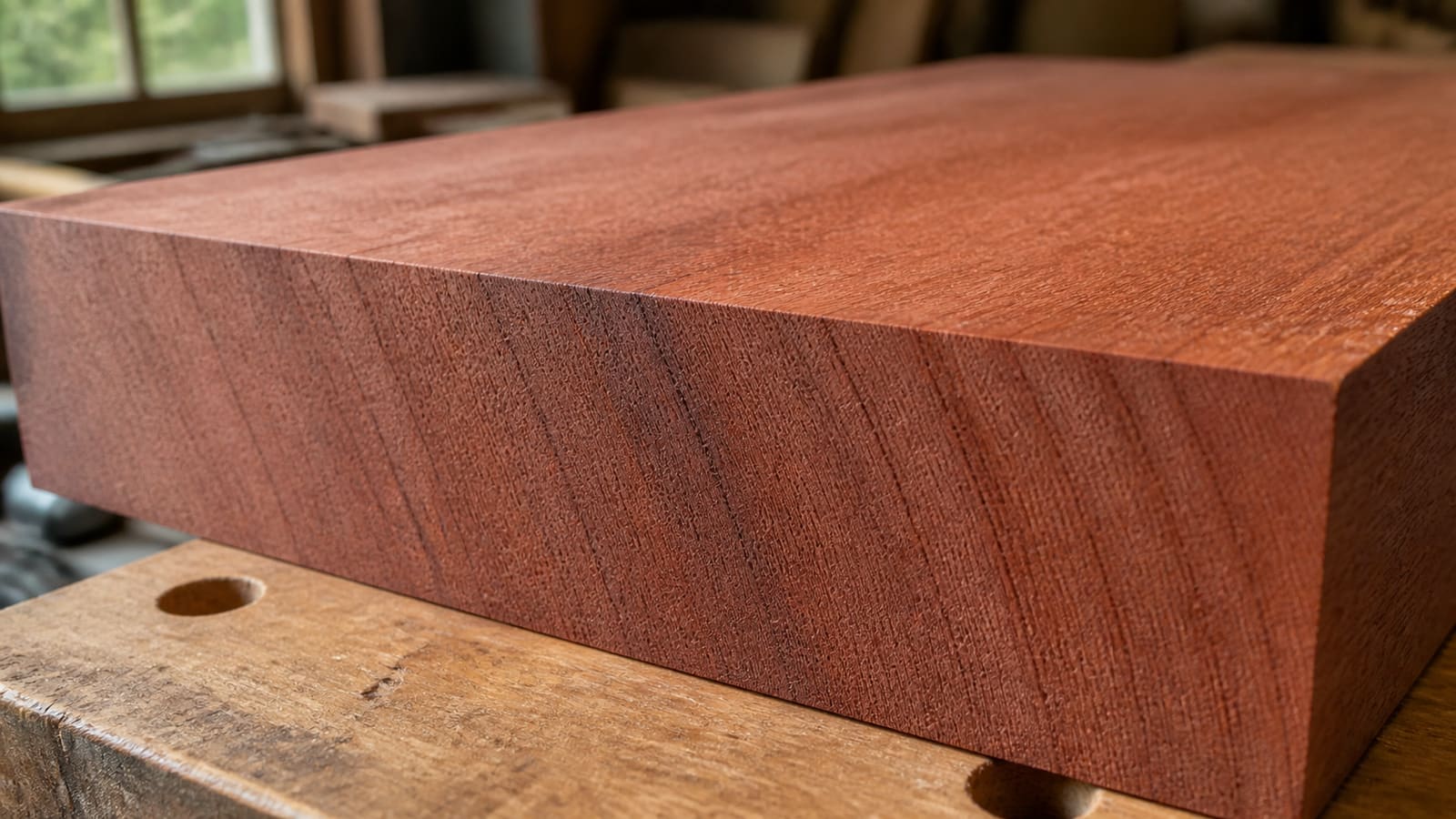
To identify mahogany wood, inspect its reddish brown heartwood, fine to medium texture, subtle luster, and open pores. Genuine mahogany often has straight or interlocked grain, while quartersawn boards can show ribbon stripe. Face grain helps narrow the options, but a clean end-grain view is more useful for separating mahogany from sapele and stained cherry.
What does mahogany wood look like?
The name mahogany can refer to several related or commercially similar woods. Genuine mahogany usually means species in the Swietenia genus, including Honduran mahogany and Cuban mahogany. African mahogany belongs to the Khaya genus. Sapele is a different species, Entandrophragma cylindricum, although it is sometimes sold as a mahogany substitute.
Fresh genuine mahogany heartwood may be pinkish brown, salmon, orange-brown, or light reddish brown. Exposure to light and oxygen usually deepens it toward a richer red or brown. The sapwood is typically paler and may contrast clearly with the heartwood.
Common visual characteristics include:
- Reddish brown, pinkish brown, or orange-brown heartwood
- Straight, wavy, or interlocked grain
- Fine to medium, generally even texture
- Medium to large visible pores
- A soft natural luster on planed surfaces
- Ribbon stripe on some quartersawn boards
- Figure ranging from plain to curly, mottled, or rope-like
Color alone is weak evidence. Cherry, sapele, African mahogany, meranti, Spanish cedar, and stained domestic hardwoods can all occupy a similar color range. Finish, age, lighting, and camera processing can make the overlap even greater.
Treat reddish brown color as a starting clue, not a species-level diagnosis. Grain structure and end-grain anatomy carry more weight.
Mahogany is commonly found in furniture, architectural trim, doors, cabinetry, boat interiors, instruments, and decorative veneer. The intended use may support an identification, but it cannot prove one.
Is ribbon stripe a reliable mahogany clue?
Ribbon stripe appears when interlocked grain is quartersawn. The grain direction changes in successive growth layers, causing alternating light and dark bands along the length of the board. These bands shift as the viewing angle changes because adjacent layers reflect light differently.
Mahogany can show ribbon stripe, but the feature is not exclusive to mahogany. Sapele is particularly well known for bold, regular ribbon stripe. African mahogany, utile, and several other tropical hardwoods can produce a similar effect.
On genuine mahogany, ribbon figure may be broad, subtle, or slightly irregular. Sapele often has narrower, more consistent stripes with stronger contrast. This is a useful tendency, not a fixed rule. Board orientation, tree growth, surface preparation, and finish all affect the result.
To examine ribbon stripe:
- Place the board under a single soft light source.
- Look along the board rather than directly down at it.
- Tilt the surface slowly from side to side.
- Watch for alternating bands that reverse from light to dark.
- Compare the stripe spacing, regularity, and contrast.
True ribbon stripe should move or reverse with changing light. Printed grain, pigmented stain, or surface wear will not create the same optical shift.
For broader help reading figure, rays, pores, and growth-ring patterns, see wood grain patterns explained.
Which face-grain features help identify mahogany wood?
Face grain includes both flatsawn and quartersawn surfaces. Begin with an unfinished or freshly exposed area. Old finish can fill pores, exaggerate color, and hide the natural texture.
Grain direction
Genuine mahogany is often straight grained, but interlocked, wavy, or irregular grain is also common. Quartersawn interlocked grain may produce ribbon figure. Flatsawn boards can show broad cathedral patterns, although these are usually less sharply defined than those of ring-porous woods such as oak or ash.
Pores and texture
Mahogany has visible vessel pores distributed across the growth ring. It is generally diffuse porous, meaning there is not a dramatic row of very large earlywood pores followed by tiny latewood pores. The surface tends to feel fine to medium textured rather than glassy smooth like hard maple or very coarse like many oaks.
On a planed face, pores may appear as short dark lines following the grain. Under finish, they can form shallow channels or small dark openings. Open-pore finishes preserve this texture, while grain filler can make it harder to see.
Color variation
Heartwood color often varies within one board. Look for warm pink, red, orange, and medium brown tones rather than a perfectly uniform red stain. Genuine aged mahogany can become quite dark, especially beneath amber shellac or old varnish.
Rays and growth rings
Mahogany rays are typically much less conspicuous than the broad ray fleck seen in quartersawn oak. Growth-ring boundaries may be visible, but they usually do not create the high-contrast pore bands associated with ring-porous species.
A hand lens in the 10x range can help reveal pores, rays, and deposits. Take photographs before applying water, mineral spirits, oil, or finish because wetting changes both color and contrast.
What should mahogany end grain look like?
End grain is one of the strongest practical clues when you need to identify mahogany wood. Cut or sand the end cleanly before examining it. A rough saw cut crushes fibers and fills pores with dust, making unrelated species look similar.
Genuine mahogany is usually diffuse porous. Its medium to large vessels are spread across the growth ring rather than concentrated into an obvious earlywood row. Pores may be solitary or arranged in short radial multiples. Some can contain dark or reddish deposits.
Look for this combination:
- No strong ring-porous band
- Medium to large pores visible with a hand lens
- Solitary pores and short radial groups
- Fine rays that do not dominate the surface
- Growth boundaries that may be subtle
- Fairly even pore distribution from earlywood to latewood
Prepare a sample by trimming it with a sharp block plane, chisel, razor, or fine sanding sequence. Sanding alone can pack dust into the vessels, so finish with a clean slicing cut when possible. Brush away dust and view the surface under angled light.
Photograph the entire cross section first, then take a close view that fills the frame with the cleaned end grain. Our guide to identifying wood by end grain explains how to expose pores and growth rings without distorting them.
End-grain anatomy can narrow an identification to a useful group, but visual examination may not separate every Swietenia species. A wood anatomist may need microscopic features and verified reference samples for a formal identification.
How can you test an unknown mahogany board step by step?
Use several independent clues instead of relying on the strongest-looking feature. A red color or ribbon stripe can be persuasive, but each occurs in many species.
- Find bare wood. Inspect an unfinished edge, drawer back, hinge recess, underside, or fresh offcut. Do not judge only through stain or varnish.
- Confirm that it is solid wood. Check whether the grain continues around edges. Veneer can place a mahogany face over a different core.
- Record the natural color. Compare heartwood and sapwood where both are present. Note whether the red tone is in the fibers or concentrated near the surface.
- Inspect the face grain. Look for straight or interlocked grain, medium texture, visible pores, and possible ribbon stripe.
- Prepare the end grain. Make a clean cut and use a hand lens to evaluate pore size and distribution.
- Check weight and hardness cautiously. Genuine mahogany is typically moderate in weight and workable, but moisture content and exact species create wide variation.
- Compare likely alternatives. Focus on sapele, African mahogany, cherry, Spanish cedar, and red-stained hardwoods.
- Photograph multiple views. Capture face grain, end grain, an unfinished edge, and the full object in neutral light.
A photo-based Wood Identifier can compare visible patterns across several candidate species. Use its result as one piece of evidence, then verify it against end grain, finish history, construction details, and provenance.
Avoid destructive tests on valuable furniture. Do not cut a finished show surface or apply solvents without knowing how the coating will react. An existing screw hole, damaged edge, or concealed underside is usually safer.
How do mahogany and sapele differ?
Sapele is one of the most common mahogany lookalikes. Both can have reddish brown heartwood, interlocked grain, medium texture, visible pores, and ribbon stripe. A single finished face can be difficult to classify with confidence.
Sapele often starts with a deeper red-brown or purplish brown cast. Its ribbon stripe tends to be narrower, stronger, and more regular than the stripe commonly seen in genuine mahogany. Sapele can also have a slightly denser, more uniform visual character.
Genuine mahogany is often warmer and more orange, pink, or golden when freshly cut. Its grain may appear calmer, and ribbon figure can be broader or less mechanically regular. It is frequently praised for predictable machining, although interlocked sections can still tear out.
On end grain, both woods are diffuse porous and can show similar vessel arrangements. Sapele may show more noticeable bands of marginal parenchyma, which can appear as fine lines across the end grain. These lines are easier to assess on a clean surface with magnification. Their absence in a small sample does not prove genuine mahogany.
Weight can support the comparison. Sapele is often heavier and harder than genuine mahogany, but board-to-board overlap is possible. Moisture content, growing conditions, and species variation prevent weight from serving as a decisive test.
If a board has dramatic, tight ribbon stripe, deep red-brown color, substantial weight, and fine end-grain banding, sapele becomes a strong candidate. If it has warmer color, a more varied figure, moderate weight, and a less regular stripe, genuine mahogany may be more likely.
For another close color comparison, read walnut vs mahogany.
How can you separate mahogany from stained cherry?
Cherry is often stained red-brown to imitate aged mahogany. This is especially common in factory furniture, cabinets, and interior trim. The stain may be labeled “mahogany” even when the underlying wood is cherry, birch, maple, poplar, or a mixed hardwood.
Cherry usually has a finer, smoother texture and smaller pores than genuine mahogany. Its face grain can contain small dark gum pockets, short black streaks, and subtle curly figure. Mahogany generally has more obvious open pores and a medium rather than very fine texture.
Fresh cherry heartwood is often light pinkish brown. It darkens substantially with light exposure, developing a warm red-brown color. Stained cherry may look very even across boards because the finish was designed to standardize natural variation.
Check concealed areas for evidence of stain. A scratch, worn corner, unfinished drawer side, or hardware recess may reveal pale wood below a dark red surface. End grain can also expose stain concentration because it absorbs more pigment and may look much darker than the adjacent face.
Cherry end grain usually has smaller pores that are harder to see without magnification. Growth-ring boundaries can be more distinct than in mahogany. Genuine mahogany typically presents larger, more evident pores across the ring.
The following signs favor stained cherry over mahogany:
- Very fine, smooth texture with small pores
- Dark gum pockets or narrow black streaks
- Red color concentrated near the finished surface
- Pale pinkish wood beneath scratches or fittings
- End grain that absorbed stain much more heavily
- Grain lacking interlocked or ribbon characteristics
Learn more about cherry’s color change and gum features in how to identify cherry wood.
What makes furniture and trim harder to identify?
Furniture and architectural trim rarely provide a perfect reference sample. Finish changes color, pore filler masks texture, and veneer conceals the supporting wood. Manufacturers may also use mahogany for visible parts while choosing another species for drawer interiors, backs, secondary framing, or hidden moldings.
Start by deciding whether the visible surface is solid wood, veneer, or a printed product. Repeating figure across wide panels may indicate veneer matching. A thin face layer visible at a chipped edge is stronger evidence. The guide to solid wood vs veneer vs laminate covers these construction clues in detail.
On furniture, inspect:
- Undersides of tables and chairs
- Inside door hinge recesses
- Drawer fronts viewed from behind
- Worn corners and damaged edges
- Screw holes and hardware recesses
- Unfinished backs of removable trim
Do not assume every reddish component is the same species. A mahogany veneered tabletop might have poplar rails, beech legs, and plywood beneath the veneer. Antique furniture may also contain repairs from several periods.
Construction date and origin can help establish which species were commercially plausible. They should not override anatomy. Trade names have changed, and “mahogany” has long been used loosely for appearance, color, or marketing.
Frequently asked questions
Does real mahogany always have ribbon stripe?
No. Ribbon stripe depends on interlocked grain and how the log was sawn. Flatsawn genuine mahogany may show broad arches or relatively plain grain. Even quartersawn material can have subtle stripe. Its absence does not rule out mahogany, and its presence does not exclude sapele or African mahogany.
Is mahogany always dark red?
No. Fresh heartwood can be light pinkish brown, salmon, orange-brown, or medium brown. It often darkens with age and light exposure. Old shellac, varnish, stain, and pore filler can make it appear much darker or redder than the raw wood.
Can smell identify genuine mahogany?
Odor is not a dependable primary test. Fresh cutting may release a mild scent, but it can fade quickly and varies among species and individual observers. Finishes, storage odors, mold, and other woods in a workshop can interfere. Use odor only as a secondary observation.
Is African mahogany the same as genuine mahogany?
No. African mahogany generally refers to species in the Khaya genus. Genuine mahogany refers to Swietenia. They can look similar and are used for many of the same purposes, but they are botanically distinct. Commercial labels do not always make the distinction clear.
Can a photo prove that wood is mahogany?
A photo can support a likely identification, especially when it shows clean face grain and end grain in neutral light. It usually cannot prove the exact species when close lookalikes share color, pore size, and interlocked grain. Multiple views, construction context, and microscopic examination improve confidence.
What is the most useful single test for mahogany?
A clean end-grain inspection is usually more informative than color. It reveals pore distribution, vessel groupings, growth boundaries, rays, and possible parenchyma bands. Combine that view with face-grain texture and ribbon characteristics rather than treating it as a standalone answer.
Identify wood with AI
Photograph the face grain, a clean end-grain section, and any unfinished edges. The Wood Identifier iOS app can compare those visible features with likely species for lumber, furniture, trim, and veneer. Download Wood Identifier on the App Store, then confirm the result using pore structure, grain direction, and the object’s construction.
Identify wood with AI
Snap a photo of lumber, furniture, or grain — the Wood Identifier app helps you recognize the species in seconds.