October 11, 2026 · 12 min read
Identify Poplar Wood: Color, Grain and Stain
Learn how to identify poplar wood by its greenish heartwood, fine diffuse pores, soft texture, paint-grade use, and stained lookalikes.
By Mario Saputra · Last reviewed October 11, 2026
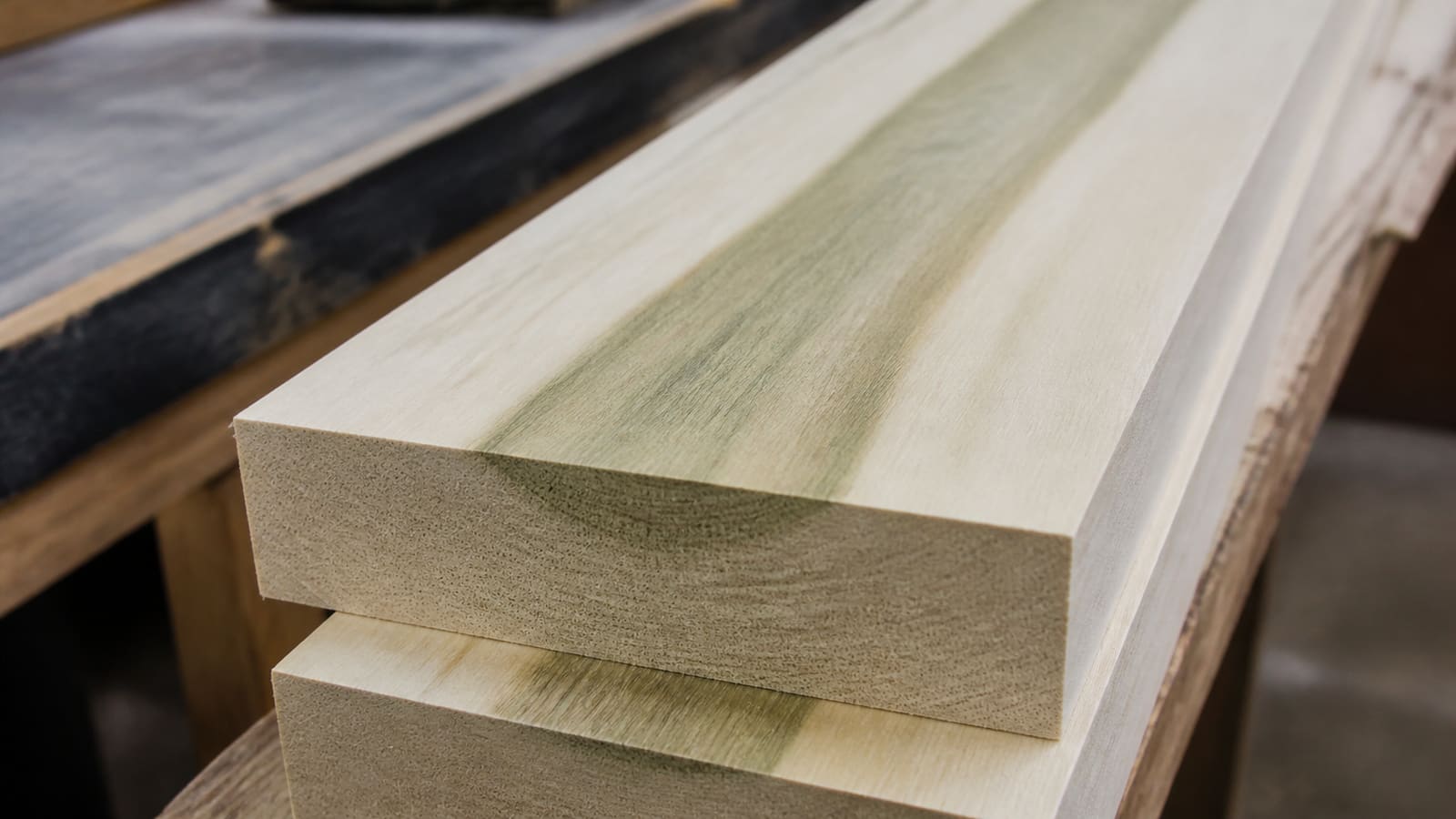
To identify poplar wood, look for pale cream sapwood, greenish or gray-brown heartwood, fine diffuse pores, and a generally straight, subdued grain. The wood is relatively soft for a hardwood and is commonly used for painted furniture, trim, cabinets, and interior millwork. Stain can disguise these traits, making poplar resemble maple, cherry, or even walnut.
In North American lumberyards, “poplar” usually means yellow poplar or tulip poplar, Liriodendron tulipifera. It is not a true poplar in the botanical genus Populus, but the lumber trade commonly uses the shorter name. This guide focuses mainly on yellow poplar while noting where true poplars may differ.
What does poplar wood look like?
Unfinished yellow poplar is usually light cream, pale yellow, or light tan. Boards often contain darker heartwood streaks that appear olive green, gray, brown, or occasionally purple-black. These irregular color zones are among the most useful clues when trying to identify poplar wood before it has been stained or painted.
The grain is typically straight and even. Some boards show gentle waves or subtle cathedral patterns on flat-sawn faces, but poplar usually lacks the dramatic grain of oak, ash, walnut, or elm. Its surface can appear almost plain from a distance.
Common visual characteristics include:
- Pale cream to yellowish sapwood
- Green, olive, gray, tan, or brown heartwood streaks
- Straight, uniform grain on many boards
- Fine, evenly distributed pores
- Low natural luster compared with cherry or hard maple
- Occasional dark mineral streaks or discoloration
- Soft, slightly fuzzy fibers after dull-tool machining
Color varies between trees and even within one board. A clear cream-colored piece may have no green at all, while another board may contain a wide olive-gray center. Color should support an identification rather than serve as the only evidence.
Fresh green areas can also change after exposure to air and light. Olive tones may become tan, brown, or muted gray. A finished or aged surface may therefore look quite different from freshly planed wood.
Can green or gray heartwood identify poplar?
Greenish heartwood is a strong clue for yellow poplar, especially when it appears beside pale cream sapwood. It is not absolute proof. Staining, water exposure, fungal discoloration, mineral streaks, and old finish can produce similar colors in other woods.
The characteristic color can range from faint green-gray to dark olive or brown. On some boards, the transition between pale sapwood and darker heartwood is abrupt. On others, the colors blend through irregular streaks. Freshly exposed end grain may reveal the contrast more clearly than a dirty face grain surface.
True poplars in the Populus genus, including aspen and cottonwood, are generally pale and less likely to show the distinctive olive heartwood associated with yellow poplar. They can also be lighter, softer, and fuzzier. Geographic location and the object’s likely source help separate these woods.
A green cast is useful evidence, but fine diffuse pores, moderate light weight, softness, and intended use should agree with the color clue.
Do not confuse green heartwood with pressure-treated lumber. Treated softwood often has a green or brown chemical tint, visible growth-ring contrast, and larger resinous softwood structure rather than hardwood pores. Fastener marks, outdoor dimensions, and treatment stamps may offer additional context.
How do poplar grain and pores appear?
Yellow poplar is diffuse-porous. Its vessels are distributed relatively evenly through the growth ring rather than concentrated into a band of large earlywood pores. This gives the wood a fine, consistent texture.
By comparison, oak and ash are ring-porous. Their earlywood contains rows of large, visible pores. Oak also has prominent rays that may appear as long lines on quarter-sawn faces or reflective flakes on radial surfaces. Poplar lacks those conspicuous oak ray patterns.
Under a hand lens, clean poplar end grain should show small pores spread across the surface. The pores may be difficult to see without magnification, particularly if sanding dust has filled them. A sharp block plane, chisel, or razor can expose a cleaner area, provided the object can be sampled without damage.
Growth rings are often visible but not strongly defined by pore size. They may appear as modest color bands. On face grain, the result is a calm pattern with less contrast than ring-porous species.
For a closer explanation of pore arrangement and sawing patterns, see wood grain patterns explained. If you can inspect a cut edge, the methods in identifying wood by end grain can help confirm whether the structure fits poplar.
Poplar can develop interlocked or irregular grain around knots and branch areas. These sections may tear during planing. They do not represent the typical grain across most commercial boards.
Why is poplar commonly called paint-grade wood?
Poplar is widely used under paint because it machines easily, accepts primer well, and has a relatively smooth, unobtrusive grain. It is also commonly available in clear, wide boards. Cabinetmakers use it for face frames, drawer parts, furniture frames, moldings, and other interior components where the finished color will come from paint.
The term “paint-grade” describes a common use, not an inferior species. Properly prepared poplar can produce a smooth painted surface. Its softness, however, means that exposed edges and corners may dent more easily than hard maple or oak.
Several practical traits encourage painted use:
- Its fine texture does not leave large open pores beneath paint.
- Pale sapwood is easy to cover with a suitable primer.
- Straight grain allows clean milling with sharp tools.
- Wide, knot-free boards are often available.
- Natural green or gray patches become irrelevant under opaque paint.
Color variations are one reason builders may avoid clear finishes on poplar. A board with cream sapwood and olive heartwood can look mismatched when coated with clear varnish. Paint creates a uniform appearance across boards.
Old painted furniture may contain poplar in hidden structural areas even when visible surfaces are cherry, walnut, mahogany, or veneer. Look at drawer sides, secondary rails, backs, and interior framing. These locations may preserve unfinished wood and reveal the pale color, fine pores, and occasional green streaks.
Paint alone cannot identify the substrate. Pine, maple, birch, medium-density fiberboard, and finger-jointed stock are also used under paint. Inspect chipped edges, screw holes, drawer interiors, or unfinished undersides before deciding.
Why is stained poplar mistaken for maple or cherry?
Poplar has a fine, closed-looking texture that can resemble maple after both woods are stained. A reddish-brown finish may also imitate the general color of cherry. Once pigment obscures poplar’s green and cream variation, species identification becomes harder.
Poplar compared with maple
Hard maple is typically heavier, harder, and more resistant to fingernail pressure. Its pale wood may have subtle curls, bird’s-eye figure, or small brown flecks, although plain maple can be visually quiet. Both species are diffuse-porous, so pore size alone may not separate them in a finished object.
Stained poplar often absorbs color unevenly. End grain, soft fiber areas, and localized patches may become noticeably darker. Maple can also blotch, so this behavior is only supporting evidence. Check protected raw areas and compare weight and dent resistance.
Hard maple generally produces crisper edges and withstands wear better. Poplar edges may show small compression dents on furniture that otherwise appears lightly used. Learn more about maple structure in the guide to identifying hard maple wood.
Poplar compared with cherry
Fresh cherry is often pinkish tan or salmon-colored rather than the deep red-brown associated with aged cherry furniture. It tends to darken with light exposure. Cherry may show fine gum pockets, small dark streaks, and a warm natural luster.
Poplar stained with a cherry-colored product can imitate that broad color range, but it usually lacks cherry’s natural depth and aging pattern. Scratches or worn corners may expose pale cream or green-gray wood beneath the reddish finish. Hidden surfaces are particularly valuable because manufacturers may stain only visible faces.
Cherry and poplar are both relatively fine-textured diffuse-porous hardwoods. Weight and hardness overlap enough that neither test should stand alone. A combination of raw color, end grain, wear, pore structure, and construction context is more dependable.
Could stained poplar resemble walnut?
Dark brown stain is frequently used to give poplar a walnut-like appearance. Genuine black walnut normally has naturally brown heartwood beneath scratches and in protected areas. Poplar usually reveals pale or greenish wood when the finish is removed.
Walnut also tends to have more visible pores and richer natural grain contrast. If a deep scratch exposes nearly white wood, the piece may be stained poplar, maple, birch, or another pale species rather than walnut.
How can you test an unknown board for poplar?
Begin with non-destructive observations. Avoid sanding valuable furniture, antiques, flooring, or finished architectural wood unless you own the piece and know that surface alteration is acceptable.
Use this inspection sequence:
- Find a raw area. Check the underside, inside a hardware hole, back edge, drawer side, or fresh offcut.
- Compare sapwood and heartwood. Look for pale cream wood with green, olive, gray, or brown zones.
- Study the grain. Expect mostly straight grain without large oak-like pores or prominent rays.
- Inspect clean end grain. Use magnification to look for small, evenly distributed pores.
- Estimate hardness. On scrap only, compare denting with a known sample. Poplar is softer than hard maple and many oaks.
- Judge weight. Yellow poplar is generally moderate to light for a hardwood, although moisture and board dimensions affect this impression.
- Consider the object. Painted trim, cabinet frames, furniture interiors, and secondary components commonly use poplar.
- Take several photographs. Capture face grain, end grain, color transitions, and an unfinished area.
A fingernail test is imprecise and can damage a finish. It is better performed on an offcut. Yellow poplar typically dents more readily than hard maple, but comparisons depend on growth conditions, moisture content, and the pressure applied.
Odor is not a strong primary test. Freshly cut poplar may have a mild or distinctive smell, but it is less reliable than cedar’s aroma and can fade quickly. Finish, age, and storage conditions further weaken scent evidence.
Burn tests are unnecessary and unsafe for finished, treated, or unknown wood. Coatings and preservatives can release harmful fumes. Structural observation offers more useful evidence without destroying the sample.
For image-based checking, photograph the board in soft daylight and include more than one surface. A photo-based wood identifier can compare visible traits, but paint, dark stain, glare, and low resolution reduce confidence. The guide to photographing wood for AI identification explains how to capture useful grain detail.
What woods are commonly confused with poplar?
Yellow poplar overlaps visually with several pale, fine-textured hardwoods. Context and multiple physical traits are needed to narrow the possibilities.
| Possible lookalike | Similarity to poplar | Useful difference | |---|---|---| | Hard maple | Pale color and fine diffuse pores | Usually harder, heavier, and more wear-resistant | | Soft maple | Fine texture and moderate hardness | Often lacks olive-green heartwood; may show maple figure | | Birch | Pale, even texture and common furniture use | Often has a tighter, more uniform cream or light brown appearance | | Cherry | Fine pores and smooth grain | Usually warmer pink-brown with natural darkening and gum streaks | | Aspen | Pale, soft, and lightweight | Often more uniformly white or gray and may be fuzzier | | Cottonwood | Part of the true poplar group and relatively soft | Frequently coarser or more fibrous, with less typical olive heartwood | | Basswood | Pale, soft, and fine-grained | Usually very light, uniform, and exceptionally easy to carve | | Alder | Soft diffuse-porous wood that stains reddish | Commonly warmer tan or light brown without green heartwood |
Regional availability matters. A North American painted cabinet is more likely to contain yellow poplar than a locally built European object. In Europe, the word poplar may refer to true Populus species rather than tulip poplar.
Construction can also expose misidentification. What looks like one stained board may be a thin veneer over plywood or composite material. Repeating grain, edge banding, and a different core visible in holes indicate that the surface does not represent the whole component. If the structure is uncertain, review solid wood versus veneer and laminate.
Frequently asked questions
Is poplar a hardwood or a softwood?
Yellow poplar is botanically a hardwood because it comes from a flowering broadleaf tree. It is still relatively soft compared with hard maple, hickory, white oak, and many other hardwoods. Hardwood and softwood are botanical categories, not direct measures of dent resistance.
Does all poplar wood have a green color?
No. Some yellow poplar boards are almost entirely pale cream or light tan. Others contain broad green, olive, gray, brown, or dark mineral-colored areas. Green heartwood is helpful when present, but its absence does not rule out poplar.
Does poplar stain well?
Poplar accepts stain, but the result can be uneven or blotchy. A washcoat, conditioner, dye, or tinted topcoat may help control the appearance. Test the full finishing schedule on an offcut because cream sapwood and darker heartwood can react differently.
How can I tell poplar from maple after staining?
Inspect scratches, unfinished undersides, hardware holes, and end grain. Poplar is usually softer and may reveal cream or olive-gray raw wood beneath the stain. Hard maple is commonly heavier and more resistant to dents, but no single test is decisive.
Is tulip poplar the same as true poplar?
No. Yellow poplar or tulip poplar is Liriodendron tulipifera, a member of the magnolia family. True poplars, aspens, and cottonwoods belong to the genus Populus. Lumber sellers in North America commonly shorten yellow poplar to “poplar.”
Can poplar be identified from one photograph?
Sometimes, particularly when a clear photograph shows raw green-gray heartwood, face grain, and clean end grain. Identification is less reliable when the wood is painted, heavily stained, weathered, or shown under colored indoor light. Multiple sharp images and physical observations give a wood identifier better evidence.
Identify wood with AI
Photograph raw face grain, end grain, and any green or gray color transitions for the best comparison. Wood Identifier : Woodio can help assess visible species traits in lumber, furniture, firewood, and other wood samples, although results should be checked against hardness, pores, location, and construction.
Download the iOS app: Wood Identifier : Woodio on the App Store.
Identify wood with AI
Snap a photo of lumber, furniture, or grain — the Wood Identifier : Woodio app helps you recognize the species in seconds.