
October 19, 2026 · 12 min read
Identify Alder Wood: Grain, Knots and Cherry Tests
Learn how to identify alder wood by its fine grain, small pores, knots, modest hardness, cabinetry use, and differences from real cherry.
By Mario Saputra · Last reviewed October 19, 2026
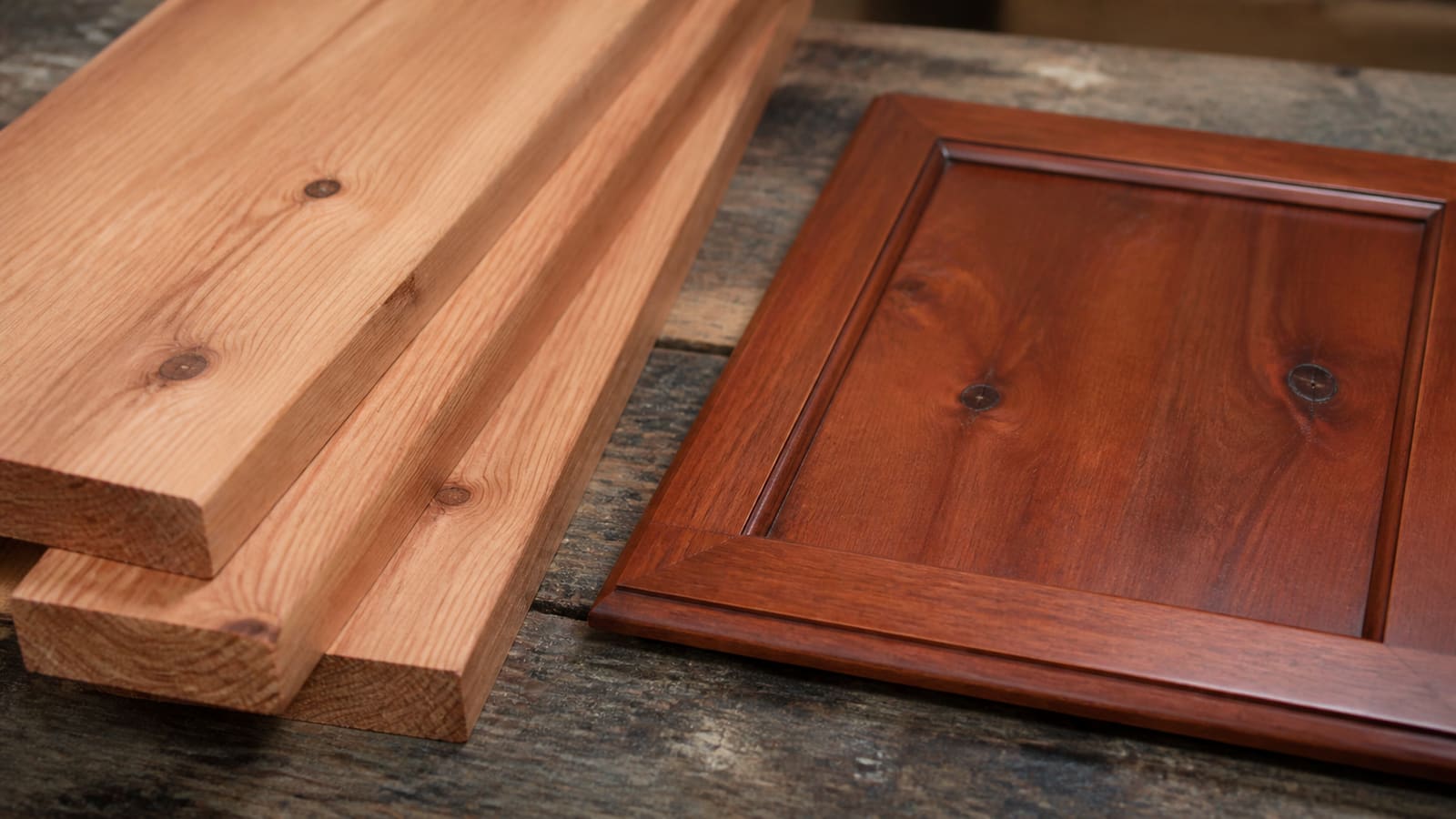
To identify alder wood, look for a fine, generally straight grain, small evenly distributed pores, modest hardness, and a pale tan to light reddish-brown color. Alder is common in cabinets and furniture, especially as clear or knotty lumber stained to resemble cherry. Because stain can hide its natural color, confirm the identification with grain, end grain, weight, knots, and an unfinished surface.
A photo-based wood identifier can narrow the options, but no single visual clue is conclusive. The strongest result comes from combining several observations and considering where the wood was used.
What does alder wood look like?
Most alder lumber sold in North America is red alder, Alnus rubra. It grows primarily in the Pacific Northwest and is widely used for cabinetry, doors, furniture, moulding, and interior millwork. European or common alder may appear in imported work, so appearance and physical properties can vary somewhat by species and growing conditions.
Freshly cut red alder is often pale cream or nearly white. Exposure to air changes it fairly quickly to tan, light brown, or a muted reddish brown. Heartwood and sapwood usually have little contrast. That lack of a sharp color boundary can help separate alder from species with distinctly darker heartwood.
Typical visual traits include:
- Fine, uniform texture with small pores
- Mostly straight grain, sometimes with mild waves or figure
- Subtle growth-ring boundaries
- Pale tan, light brown, or soft reddish-brown color
- Fine rays that are difficult to see without magnification
- Occasional dark mineral streaks or color variation
- Sound or open knots in knotty grades
- Low natural luster compared with polished cherry
Alder is diffuse porous. Its vessels are small and spread relatively evenly across each growth ring. It lacks the obvious rows of large earlywood pores seen in ring-porous woods such as oak and ash. For more help interpreting these features, see wood grain patterns explained.
On a flat-sawn face, the grain may form subdued cathedral patterns. Quarter-sawn surfaces tend to look straighter and quieter. Neither face normally shows the bold ray fleck associated with quarter-sawn oak.
Why is alder often stained to look like cherry?
Alder has a smooth texture and a naturally warm undertone. A reddish-brown stain can make it resemble cherry at first glance, which is why alder is sometimes used as a lower-cost visual substitute in cabinets and furniture.
Its pale base accepts many stain colors, including honey, cinnamon, cherry, walnut, and dark espresso tones. Once the surface has been stained and top-coated, natural color becomes a weak identification clue. Grain structure remains more useful.
Alder is often described as taking stain evenly, but that description needs context. Its fine texture can produce a smooth final appearance, yet areas of changing grain direction may absorb pigment differently. End grain, knots, and sanded-through patches can become noticeably darker. A washcoat, wood conditioner, dye, toner, or gel stain is sometimes used to control blotching.
A convincing cherry-colored finish does not make a board cherry. Check the pores, hardness, unfinished edges, knots, and age-related color before deciding.
Real cherry often develops a deeper red-brown color with light and time. Alder may warm or mellow, but it does not usually develop the same depth and natural variation. A stain can imitate cherry color immediately, though it cannot fully reproduce cherry’s aging behavior or characteristic gum pockets.
How hard and heavy is alder wood?
Red alder is a relatively soft hardwood. Its Janka hardness is commonly listed at about 590 pounds-force. American black cherry is around 950 pounds-force, so cherry generally resists dents more effectively.
Alder feels moderately light when compared with cherry, hard maple, white oak, or hickory. A dry alder cabinet door may feel lighter than a similar solid cherry door, although construction, moisture, thickness, and hardware can overwhelm that difference.
A careful thumbnail test may leave an impression on unfinished alder. A hidden area can also be tested with a sharp awl, but only with the owner’s permission. Do not use a hardness test on a visible finished surface. Thick coatings can make soft wood feel harder, while decay or moisture can make almost any wood feel softer.
Hardness is useful as a supporting clue, not a species verdict. Poplar can be close to alder in hardness. Some soft maple species overlap with or exceed cherry. Compare suspected samples only when they have similar moisture content and surface preparation. The Janka hardness scale for common woods provides useful reference values and explains why informal tests vary.
Alder also machines easily. It cuts and sands cleanly when tools are sharp, but edges can dent during handling. Screws should be piloted near board ends, and soft fibers can compress beneath clamps. These workshop behaviors may support an identification when you can examine raw stock.
How can you tell alder from real cherry?
The easiest mistake is identifying a stained alder cabinet as cherry based only on color. Compare the wood under good light and search for unfinished material inside a drawer, behind a hinge, beneath a removable shelf, or along the back of a face frame.
Natural color and aging
Unfinished alder is usually pale tan to light reddish brown, with limited separation between sapwood and heartwood. Fresh cherry heartwood is often pinkish or salmon brown, then becomes richer and darker after exposure to light. Cherry sapwood can remain distinctly pale.
Color variation between adjacent boards is common in cherry. Alder cabinetry may look more uniform because the stain and toner were selected to equalize color.
Grain and pores
Both species have fine texture, so neither displays the coarse open pores of oak or ash. Alder’s pores are small and evenly distributed. Growth rings can be difficult to distinguish.
Cherry also has fine pores, but its growth rings are often a little easier to follow. Cherry may show gentle curly figure, fine dark gum lines, or small pitch pockets. These dark features are not present in every cherry board, but they are useful when found alongside the correct grain and color.
Knots and grade
Knotty alder is a recognized decorative grade. Cabinet doors made from it may have numerous dark knots, filled knots, cracks, and rustic color variation. Cherry can have knots, but clear cherry furniture and cabinetry are less likely to display the same deliberate pattern of large rustic knots.
Do not assume every knotty reddish cabinet is alder. Pine, birch, maple, and other species can receive similar finishes. Confirm that the visible grain is consistent with a diffuse-porous hardwood rather than a resinous softwood.
Hardness and weight
Alder usually dents more easily and feels lighter than cherry. This difference is clearest when comparing unfinished boards of equal dimensions. It is much less reliable on assembled cabinet doors or veneered panels.
Aging beneath hardware
Remove hardware only when it can be done safely. Cherry protected beneath a hinge or handle may be much lighter than the surrounding light-exposed wood. Stained alder can also show a protected color difference due to finish aging, but the contrast may be driven more by the coating than by the wood itself.
For a closer comparison with cherry’s natural traits, read how to identify cherry wood by grain, color, and age.
Where is alder commonly used?
Alder is primarily an interior wood. It is easy to machine, glues well, and can be finished in many colors. Manufacturers use clear alder for smooth contemporary work and knotty alder for rustic designs.
Common applications include cabinet doors, face frames, drawer fronts, furniture frames, turned parts, moulding, interior doors, carvings, and painted millwork. It may also appear as a core or concealed component beneath another material.
A cabinet labeled “alder” is not necessarily solid alder throughout. A door might have solid alder rails and stiles with an alder veneer panel. Cabinet boxes may use plywood or composite panels with a printed or wood veneer face. Drawer boxes can be a completely different species.
Check construction before identifying the species. Repeating grain patterns suggest veneer or printed laminate. Exposed end grain that does not match the face may reveal a veneer over a different core. The guide to identifying wood in furniture explains where unfinished evidence is most likely to be found.
Alder has limited natural decay resistance, so it is not usually the best candidate for exposed outdoor construction. Finding pale reddish wood in an old exterior application should prompt consideration of cedar, redwood, treated lumber, or a coated interior-grade wood used inappropriately.
What is the best process to identify alder wood?
Use a repeatable inspection instead of relying on one feature. Good light, a clean surface, and modest magnification are more useful than guessing from furniture style.
- Find an unfinished area. Look beneath hardware, inside a hinge mortise, under a tabletop, at a drawer edge, or on the back of a removable part. Avoid sanding valuable furniture without permission.
- Record the natural color. Pale tan or muted reddish brown with little heartwood and sapwood contrast supports alder. Dark red-brown color alone may come from stain.
- Study the face grain. Look for fine, uniform texture, small pores, subdued growth rings, and generally straight grain.
- Inspect clean end grain. Use a sharp blade or fine sanding block on scrap lumber. Alder should show small diffuse pores rather than a band of large earlywood vessels.
- Assess knots. Numerous dark, rustic knots in cabinet components can support knotty alder, especially when the surrounding wood has fine diffuse pores.
- Compare hardness and weight. Alder should feel modestly light and dent more readily than cherry, oak, or hard maple. Treat this as supporting evidence only.
- Consider the object and source. Pacific Northwest cabinetry, interior doors, and commercially labeled knotty stock make alder more plausible. Geography never proves species, but it changes the likely candidates.
- Take several clear photographs. Capture the face grain, end grain, knots, and an unfinished spot. The Wood Identifier : Woodio tool can compare visual evidence across multiple wood species.
Clean end grain is especially valuable because stain and sanding can obscure face-grain details. A 10x hand lens can reveal the even distribution of alder’s small vessels. If you are preparing a sample, cut rather than tear the fibers, then remove dust before viewing it.
What woods are commonly confused with alder?
Cherry is the best-known lookalike because alder is often given a cherry-colored finish. Several other woods can also create confusion.
Birch has fine, even texture and can be stained reddish brown. Yellow birch is generally harder than alder and may show more pronounced grain or curly figure. Pale sapwood and reddish heartwood can create stronger color contrast than is typical in alder.
Poplar is similar in hardness and is common in painted furniture and cabinet parts. Raw poplar often has cream, green, gray, or purple-brown areas. Stain may make those color shifts harder to see. Its grain can look similarly quiet.
Soft maple varies by species but often has a pale, fine-textured surface. It may be harder and heavier than alder. Maple can also show curly, bird’s-eye, or quilted figure that would be unusual in ordinary alder.
Pine may be used for rustic knotty cabinets, but its anatomy is different. Pine has no visible vessels, often shows stronger earlywood and latewood bands, and may have resinous odor or pitch. Alder is a hardwood with small vessels, even though it is softer than many familiar hardwoods.
Mahogany-colored alder can be mistaken for tropical wood based on finish alone. Genuine mahogany usually has a different pore structure, more visible ribbon grain on quarter-sawn faces, and greater depth or luster. Always identify the underlying wood rather than the stain name.
Frequently asked questions
Is alder considered a hardwood?
Yes. Alder is botanically a hardwood because it comes from a flowering broadleaf tree. Hardwood does not automatically mean hard. Red alder is softer than cherry, oak, hard maple, and many other commercial hardwoods.
Does alder always have knots?
No. Clear alder is selected to minimize knots and is used for smooth cabinetry, moulding, and furniture. Knotty alder is a separate visual grade chosen for prominent knots and rustic character. The absence of knots does not rule out alder.
Can alder look exactly like cherry after staining?
It can look convincingly similar in a quick visual inspection, especially under a dark reddish finish. Close examination usually reveals differences in natural color, grain detail, gum pockets, hardness, weight, and aging. Confirm the result at an unfinished edge or hidden surface.
What does alder end grain look like?
Alder end grain has small pores distributed across the growth ring, which is the diffuse-porous pattern. The growth-ring boundaries are usually subtle. Magnification and a clean cut help because rough sawing or finish buildup can hide the vessels. See the detailed guide to identifying wood by end grain for sample preparation tips.
Does alder darken with age?
Alder can warm and change somewhat with age, oxidation, and finish exposure. It generally does not develop the same deep red-brown patina associated with cherry. Stains and topcoats may also amber, so an older cabinet’s color reflects both wood and finish.
Can a photo confirm alder wood?
A clear photo can support an alder identification, especially when it includes face grain, clean end grain, knots, and an unfinished area. A single photograph of a stained cabinet door is less reliable. A wood identifier should be combined with physical clues and construction details when the distinction matters.
Identify wood with AI
Photograph the face grain, end grain, knots, and any unfinished surfaces in soft natural light. The AI wood identifier can help compare alder with cherry, birch, poplar, maple, and other likely candidates.
Download Wood Identifier : Woodio on the App Store to identify lumber, cabinets, furniture, firewood, and grain patterns from photos. Use the result as one part of a complete inspection, particularly when stain or veneer hides the natural wood.
Identify wood with AI
Snap a photo of lumber, furniture, or grain — the Wood Identifier : Woodio app helps you recognize the species in seconds.
