
October 26, 2026 · 11 min read
Identify Soft Maple Wood: Grain, Weight and Uses
Identify soft maple by its pale color, diffuse pores, moderate weight, wider growth rings, and differences from hard maple and birch.
By Mario Saputra · Last reviewed October 26, 2026
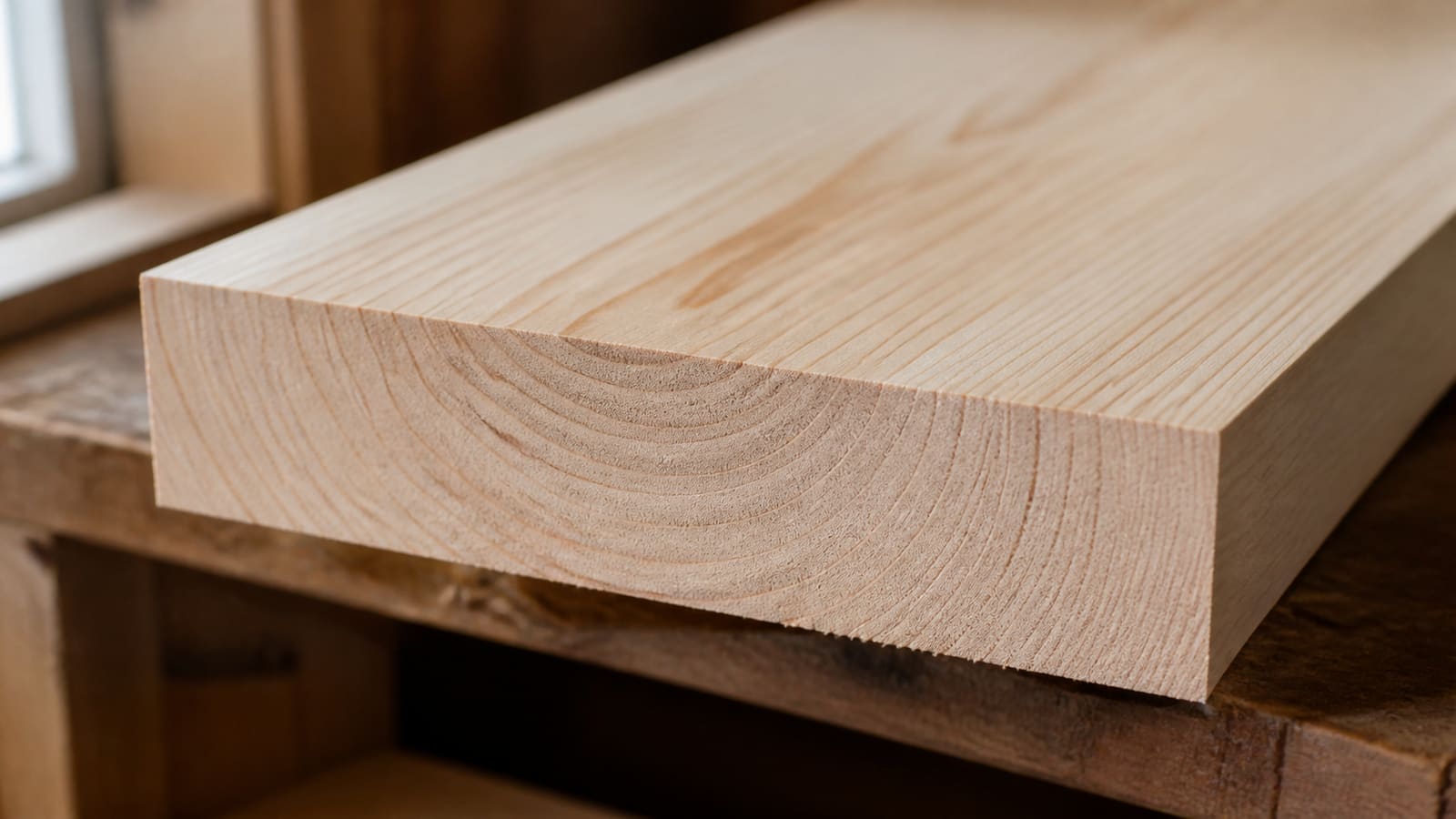
To identify soft maple, look for pale cream to light reddish-brown wood, fine diffuse pores, moderate weight, and growth rings that are often wider than those of hard maple. Soft maple usually dents more easily than hard maple, yet its grain can look nearly identical. Comparing a clean end-grain surface, weight, hardness, and board context gives the most reliable result.
What is soft maple wood?
Soft maple is not a single species. It is a commercial name for several maples that are generally lighter and softer than hard maple, also called sugar maple. Common North American soft maples include:
- Red maple, Acer rubrum
- Silver maple, Acer saccharinum
- Bigleaf maple, Acer macrophyllum
- Boxelder, Acer negundo
Red maple is one of the most common species sold as soft maple in the eastern United States. Silver maple is typically lighter and softer. Bigleaf maple is important on the West Coast and can produce figured lumber. Boxelder is less common in fine cabinetry but may appear in turning blanks and locally milled boards.
The word “soft” is relative. Soft maple is still a hardwood because it comes from a broadleaf tree. It is commonly strong enough for cabinets, millwork, furniture frames, painted doors, and interior trim. The label only separates these species from harder sugar maple and black maple.
Species within the group vary considerably. For that reason, appearance alone may support a soft maple identification without proving the exact maple species.
What does soft maple look like?
Soft maple normally has light-colored sapwood ranging from creamy white to pale tan. Its heartwood can be light brown, grayish brown, or reddish brown. Mineral streaks may create gray, olive, greenish, or dark brown lines.
The grain is usually straight and fine, although boards can show curl, quilt, bird’s-eye-like markings, or irregular grain. Bigleaf maple is particularly associated with quilted figure, but figure does not identify a species by itself.
Look for these visual clues on an unfinished or freshly exposed surface:
- Fine, even texture with no large open pores
- Pale sapwood and occasional reddish or gray-brown heartwood
- Subtle growth-ring boundaries
- Faint ray flecks on some quartersawn surfaces
- Occasional mineral streaks or small brown marks
- Wider growth rings than hard maple in many commercial boards
Maple is diffuse-porous. Its vessels are distributed relatively evenly through each growth ring rather than forming the obvious earlywood rows found in oak or ash. The face grain may therefore look smooth and subdued.
Finish can obscure these features. Amber varnish makes pale maple look yellow, while dark stain can make it resemble cherry, birch, or another close-grained hardwood. Inspect an unfinished edge, the back of a drawer, a hinge mortise, or a freshly cut end whenever possible.
For more detail on how grain direction and sawing angle affect appearance, see wood grain patterns explained.
Are wider growth rings a reliable clue?
Soft maple often has wider growth rings than hard maple, especially when comparing fast-grown red or silver maple with slow-grown sugar maple. On a flatsawn face, wider rings can create broader, more widely spaced arches. On an end-grain surface, the annual boundaries may be farther apart.
This is a useful supporting clue, not a decisive test. Growth rate responds to soil, climate, competition, tree age, and forestry practices. A fast-grown hard maple can have wide rings, while a slow-grown soft maple can have tight rings.
Ring width also changes within one tree. Wood near the pith may differ from mature outer wood. A narrow board may not show enough complete rings for a fair comparison.
Treat growth-ring width as one piece of evidence. Combine it with pore structure, weight, hardness, color, rays, and the board’s known source.
Count several rings on a clean end-grain section and measure their average spacing rather than judging one unusually broad ring. If two boards have similar dimensions and moisture content, the softer, lighter board with broader rings is more likely to be soft maple. It is still not proof on its own.
How can end grain help identify soft maple?
End grain is usually more informative than the face of the board. Sand or slice a small area cleanly because saw marks and crushed fibers can hide the vessels.
Under a hand lens, soft maple should show small pores spread across the growth ring. The pores are much less obvious than those of ring-porous woods such as oak, ash, or hickory. Growth-ring boundaries may appear as fine darker lines.
Maple rays are present but are not normally as broad and conspicuous as the large rays of oak. Hard maple and soft maple both have fine diffuse pores and similar rays, so end grain can confirm that a sample belongs to the maple-like group more readily than it can separate the two commercial categories.
Prepare the surface carefully:
- Cut across the grain with a sharp fine-tooth saw or utility blade.
- Sand the end from about 120 grit through 320 or 400 grit.
- Remove dust with a brush or compressed air.
- View the surface in bright side light with a 10× hand lens.
- Compare pore size, ring boundaries, ray width, and average ring spacing.
Do not wet the sample heavily before examining it. Water may raise fibers and make the smallest anatomical details harder to see. A light wipe can improve contrast, but allow the surface to dry before comparing color.
The methods in identify wood by end grain explain how to prepare and photograph a useful cross section.
Is soft maple lighter and softer than hard maple?
Soft maple is generally lighter than hard maple, but moisture content and species variation matter. Silver maple is usually quite light. Red maple and bigleaf maple tend to fall between silver maple and hard maple, with overlap possible between individual boards.
A weight comparison works best when boards have the same dimensions and have acclimated in the same room. A damp soft maple board can weigh more than a dry hard maple board. Hardware, finish, glue, and hidden composite panels also make furniture weight unreliable.
Hardness provides another practical clue. On the Janka scale, hard maple is commonly listed around 1,450 pounds-force. Typical values for soft maple species are lower. Red maple is often listed near 950 pounds-force, bigleaf maple around 850, and silver maple around 700. Values vary with source, growing conditions, and test sample.
A controlled indentation test can help when damage is acceptable. Try it only on scrap or a hidden area. Use the same pointed tool, pressure, and grain orientation on a known comparison sample. Soft maple should dent more readily than hard maple.
A fingernail test is less reliable. Finger strength varies, finished surfaces resist indentation, and hard latewood bands can mislead you. Never mark valuable furniture or installed cabinets for identification.
Consult the Janka hardness scale for common wood species when comparing measured or published hardness values.
How do you tell soft maple from hard maple?
Soft and hard maple can be difficult to separate visually because both have pale color, fine texture, diffuse pores, and similar grain. Use several clues together rather than expecting one defining mark.
Hard maple typically feels heavier and more resistant to denting. Its boards often have tighter growth rings, although this is not universal. Hard maple sapwood is frequently selected for a bright, nearly white appearance. Soft maple can show more gray, red, or brown cast and more mineral streaking, but lumber grade and drying also affect color.
Machining behavior may provide supporting evidence. Hard maple offers greater resistance when planed, routed, or carved. Soft maple generally cuts more easily and may produce slightly fuzzier fibers if tools are dull. Neither observation is reliable without experience and a known reference board.
Commercial use can supply context. Hard maple is preferred where wear resistance matters, including butcher blocks, bowling lanes, worktops, and some flooring. Soft maple is common in cabinet parts, painted doors, moldings, furniture frames, and turned work where lower weight and easier machining are useful.
A practical comparison should include:
- Confirm that both samples are dry and unfinished.
- Compare equal-size pieces by weight.
- Examine clean end grain under magnification.
- Compare average ring width across several rings.
- Test indentation only on disposable offcuts.
- Consider the product and its expected use.
Even after these checks, separating an individual board may remain uncertain. The distinction is often commercial rather than a simple visible boundary. See hard maple vs soft maple identification tests for a focused side-by-side comparison.
How can you distinguish soft maple from birch?
Birch is one of the closest common lookalikes. Both woods are pale, diffuse-porous, fine textured, and frequently used for cabinets, plywood, drawers, and painted millwork.
Yellow birch often has cream sapwood and reddish-brown heartwood. Its face grain can appear slightly more lustrous than soft maple, with a gentle wavy or curly pattern. Paper birch is paler and softer, making visual separation even harder.
On clean end grain, birch pores may appear somewhat more numerous or distinct, depending on species and magnification. Birch rays are fine and usually inconspicuous. Maple may show subtle ray lines more readily, but the difference is not dependable on every board.
Color is a weak clue after finishing. Birch often takes stain unevenly and can become blotchy. Maple also blotches, particularly around changing grain direction. A stained yellow-brown surface could be either species.
Use construction context where available. Birch plywood is common in cabinet boxes, drawer sides, and panels. Soft maple is frequently used for solid face frames, doors, rails, and moldings. However, manufacturers may use both in the same cabinet.
Check whether the visible “wood” is a thin face veneer before making a species call. Edge banding, repeated grain, and a layered panel edge indicate plywood or veneer rather than solid lumber. Species identification then applies only to the surface layer.
If birch remains a strong possibility, compare the sample with the features in how to identify birch wood.
Why is soft maple used for cabinetry and paint-grade work?
Soft maple offers a useful balance of strength, weight, workability, and cost. It machines more easily than hard maple while still producing crisp profiles with sharp tools. It also has a fine texture that can provide a smooth painted surface.
Cabinetmakers use it for face frames, rails, stiles, door parts, moldings, drawer components, and furniture frames. Pale color is less important under opaque paint, so boards with mineral streaks or color variation can be used efficiently.
Soft maple is often described as paint grade, but preparation still matters. Grain reversal can tear during planing. End grain absorbs primer differently from face grain. Knots, mineral streaks, and resin-like discoloration may show through a light coating if they are not sealed correctly.
For a clean painted result, sand evenly, remove dust, seal stains where necessary, and use a compatible primer. Allow the wood to reach the room’s moisture conditions before building doors or wide frames.
Soft maple can also be stained, but it may blotch. A washcoat, conditioner, dye, or sprayed toner can create a more even color than a heavy pigment stain. Always test the complete finish schedule on an offcut from the same boards.
Cabinet context can help identify soft maple, but it cannot confirm it. Birch, poplar, alder, and paint-grade hard maple can serve similar roles. Examine exposed end grain and hidden unfinished surfaces before deciding.
Frequently asked questions
Can soft maple be identified by color alone?
No. Soft maple is often cream, tan, light brown, or faintly reddish, but hard maple, birch, poplar, and alder can overlap. Finish, age, and lighting also change color. Use color with weight, pores, ring width, hardness, and construction context.
Does soft maple always have wide growth rings?
No. Soft maple often has wider rings than hard maple, but tree growth conditions cause substantial variation. Compare several rings and treat their width as supporting evidence rather than a species test.
Is red maple the same as soft maple?
Red maple is one of the main species sold as soft maple. The commercial group can also include silver maple, bigleaf maple, and boxelder. A board labeled soft maple is not necessarily red maple.
Is soft maple suitable for furniture?
Yes. It is commonly used for cabinets, tables, chairs, frames, moldings, and turned parts. It is less resistant to dents than hard maple, so hard maple may be preferable for heavily worn tops, cutting surfaces, or flooring.
Can an app distinguish soft maple from hard maple?
A photo-based result can narrow the possibilities, especially when the images show clean face grain and end grain. These maples are close lookalikes, so image quality and physical checks remain important. Photograph unfinished wood in soft daylight, include multiple grain views, and use the result as evidence rather than an absolute guarantee.
Identify wood with AI
For an uncertain board, photograph the face grain, edge, and a freshly prepared end-grain section. Remove finish where appropriate, fill the frame with the wood, and avoid glare or strong color casts. The guide to photographing wood for AI identification can help you capture useful details.
Wood Identifier : Woodio is a photo-based AI wood identifier for lumber, cabinetry, furniture, firewood, and grain analysis. Compare its suggestion with weight, growth rings, pores, hardness, and project context when trying to identify soft maple.
Download Wood Identifier : Woodio on the App Store for iOS and photograph several clean views for the strongest wood identifier result.
Identify wood with AI
Snap a photo of lumber, furniture, or grain — the Wood Identifier : Woodio app helps you recognize the species in seconds.
