
November 2, 2026 · 11 min read
Identify Douglas Fir Lumber by Grain and Color
Identify Douglas fir lumber using latewood bands, pinkish heartwood, resin canals, end grain, grade stamps, and pine and spruce comparisons.
By Mario Saputra · Last reviewed November 2, 2026
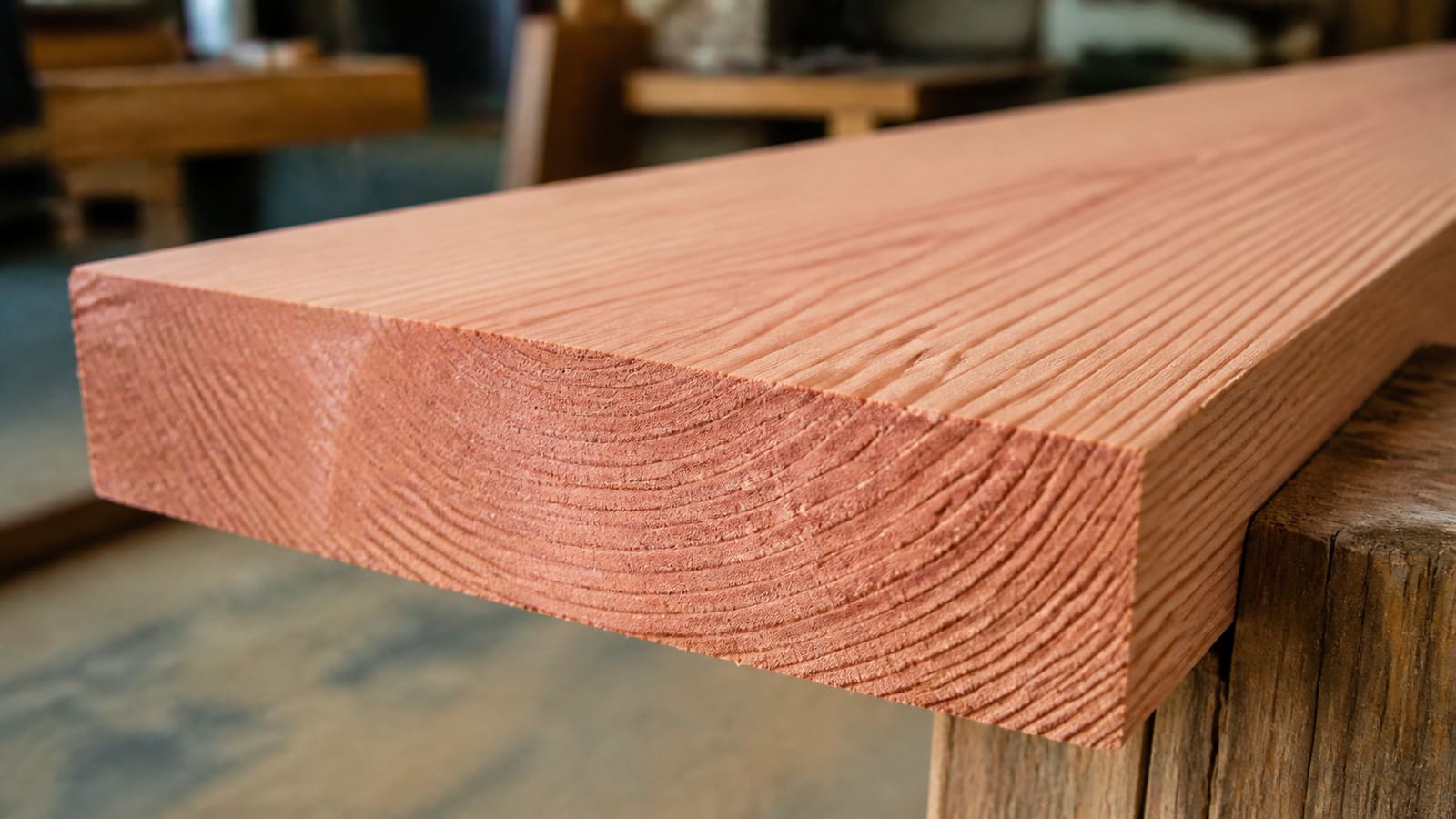
To identify Douglas fir lumber, look for strong growth-ring contrast, narrow dark latewood bands, and heartwood that often appears pinkish tan to reddish brown. End grain may show small, scattered resin canals, while construction lumber often carries a Douglas fir or DF-L grade stamp. Compare several features because color, weight, and grain can vary with age, growth conditions, and surface finish.
What does Douglas fir lumber look like?
Douglas fir, botanically Pseudotsuga menziesii, is a softwood even though its mature wood can feel relatively hard and dense. It is not a true fir. Most commercial lumber comes from coast Douglas fir or interior populations, which can differ in color, ring width, and density.
Fresh sapwood is usually pale cream, yellowish white, or light tan. Heartwood often has a pink, salmon, orange-brown, or reddish cast. Exposure to light and air can deepen it toward warm brown. Older lumber may lose much of its original pink tone, especially under dirt, oxidation, stain, or amber-colored finish.
The grain is generally straight. Flat-sawn boards can display bold, cathedral-shaped growth-ring patterns. Quarter-sawn or vertical-grain boards show straighter, more evenly spaced stripes. Compared with many pale spruces and true firs, Douglas fir usually has a stronger contrast between light earlywood and darker latewood.
Useful visual clues include:
- Pale sapwood with pinkish, salmon, or reddish-brown heartwood
- Straight grain in clear boards
- Distinct dark latewood lines separating lighter earlywood
- Small resin canals rather than the large, obvious canals found in many pines
- Moderate to heavy weight for common softwood lumber
- A firm surface that may splinter along the grain
- Occasional resin pockets or pitch streaks
- Construction stamps marked D FIR, Douglas Fir, or DF-L
No single item proves the species. The best identification combines face grain, end grain, color, weight, odor, resin anatomy, and any reliable mill markings.
Why are the latewood bands so important?
Douglas fir typically produces a clear boundary between spring growth and later growth. The light earlywood consists of larger, thinner-walled cells. The darker latewood contains smaller cells with thicker walls, creating a dense band that may feel slightly raised after softer earlywood wears away.
On a clean end-grain surface, the growth rings often look sharply defined. The transition from earlywood to latewood can be fairly abrupt, although it varies with the tree and growing region. This contrast gives flat-sawn Douglas fir its bold grain and makes vertical-grain stock appear striped.
Latewood bands can also affect machining. Earlywood cuts or sands more quickly than dense latewood. Aggressive sanding may produce an uneven surface, while weathering can leave ridges as the softer earlywood erodes first.
Ring width alone is not diagnostic. Fast-grown construction lumber may have broad rings. Slow-grown old-growth material can have narrow, closely spaced rings. Both may be Douglas fir if the color, transition, density, and other anatomical clues agree.
For a wider explanation of ring orientation and figure, see wood grain patterns explained.
The strongest field clue is usually not color alone. It is the combination of pinkish heartwood, straight grain, and dense latewood bands that stand out clearly from the earlywood.
Can resin canals identify Douglas fir?
Douglas fir has normal resin canals in both axial and radial tissues. On prepared end grain, the axial canals may appear as tiny dots, often concentrated in the later portion of a growth ring. They are usually much smaller and less conspicuous than the canals seen in many pine species.
A hand lens can help, but surface preparation matters more than magnification. A rough saw cut crushes fibers and fills openings with dust. Slice the end grain with a sharp knife or finely sand it before looking for canals.
Resin canals should be treated as supporting evidence. Their size and frequency vary, and traumatic resin canals can form after injury to the living tree. These may appear in unusual rows and should not be mistaken for the normal pattern.
The main practical comparison is:
- Pine often has larger, easier-to-see resin canals.
- Douglas fir generally has small, scattered canals.
- Spruce also has small resin canals, so canals alone may not separate spruce from Douglas fir.
- True firs lack normal resin canals, although damaged wood can contain localized resin features.
Microscopic anatomy can provide a firmer answer, but most workshop identification does not require it. Start with a clean end-grain inspection and combine the result with color and growth-ring contrast. The method in identify wood by end grain explains how to prepare and examine this surface.
Does Douglas fir always have pinkish heartwood?
Pinkish or reddish heartwood is common, but it is not guaranteed. Young boards may contain mostly pale sapwood. Interior-grown trees can produce lighter wood, and freshly planed surfaces may look different from aged ones. Clear finish, stain, ultraviolet exposure, grime, and heat can all alter the apparent color.
Color is most useful on a newly exposed area. Plane a small section, scrape an inconspicuous edge, or inspect a protected end. Compare the fresh surface with the weathered face. If the protected wood shows a warm salmon or reddish-brown cast plus strong latewood lines, Douglas fir becomes more likely.
Avoid using photographs with automatic white balance as your only color reference. Warm indoor lighting can make spruce look pink. Cool lighting can make Douglas fir appear gray. Include a neutral gray or white reference when photographing a sample.
Old framing presents another problem. Douglas fir may darken to deep orange-brown, especially in dry attics or old buildings. Historic pine can age in a similar way. In that situation, end grain, resin canals, ring transitions, weight, and regional construction history become more valuable than face color.
Can construction stamps confirm Douglas fir framing?
A readable grade stamp is one of the most useful clues on modern framing. Marks such as “D FIR” may identify Douglas fir directly. “DF-L” usually refers to the Douglas Fir-Larch species group used under North American grading rules. A group stamp does not necessarily prove that an individual board is Douglas fir because western larch may be included.
Stamps may also show the grading agency, mill number, moisture condition, and structural grade. “S-DRY” or “KD” concerns moisture, not species. “No. 2” is a grade, not a wood type. “SPF” identifies a spruce-pine-fir group and is not a Douglas Fir-Larch stamp.
Construction context can support identification. Douglas fir is widely used for studs, joists, rafters, beams, posts, and plywood. It is valued for its strength-to-weight ratio and stiffness. Older buildings in western North America commonly contain it, sometimes in large, clear pieces that differ from current plantation-grown framing.
Do not identify structural lumber solely to decide whether it can carry a load. Species is only one part of structural performance. Grade, knots, checks, decay, moisture, span, previous notching, and code requirements also matter. Consult a qualified professional before reusing uncertain framing in a structural application.
How is Douglas fir different from pine and spruce?
Douglas fir overlaps visually with both pine and spruce, especially after weathering. Side-by-side comparison is more reliable than trying to match a board to a single reference photo.
Douglas fir vs pine
Many pines are paler and softer, with resin canals that are larger and easier to see on clean end grain. Pine can also have a more noticeable resinous odor and sticky pitch. Species such as eastern white pine tend to have gentler earlywood-to-latewood transitions than Douglas fir.
Southern yellow pine is a harder comparison. It can have dense, dark latewood and strong growth-ring contrast. Its resin canals are typically more prominent, and its grain can look coarser. Douglas fir often has a more uniform pinkish or reddish cast and smaller canals. For pine-specific clues, read how to identify pine wood by grain and knots.
Douglas fir vs spruce
Spruce is commonly pale cream to nearly white, sometimes with a faint yellow or pink cast. It often feels lighter and has less dramatic heartwood coloration. Its growth rings can be clear, but the overall face grain is frequently more subdued than Douglas fir.
Both woods can have small resin canals, so a lens may not settle the question. Douglas fir’s darker latewood bands, warmer heartwood, and greater apparent density often provide better workshop clues. A stamp marked SPF points toward a commercial species group containing spruce, pine, or fir rather than Douglas Fir-Larch.
Douglas fir vs true fir
True firs in the genus Abies are usually pale and relatively uniform. They lack normal resin canals and often show less color separation between sapwood and heartwood. Douglas fir generally has bolder latewood and warmer mature heartwood. Despite the name, Douglas fir belongs to a different genus.
How should you test an unknown board?
Use a repeatable process instead of making a decision from one face. This reduces errors caused by stain, weathering, rough milling, or unusual growth.
- Check labels and context. Record grade stamps, supplier notes, building age, and geographic location. Treat species-group stamps as evidence rather than absolute proof.
- Expose clean wood. Scrape or plane a small area that has no paint, finish, oxidation, or embedded dirt.
- Inspect the color. Look for pale sapwood and warmer pink, salmon, orange-brown, or reddish heartwood.
- Study the face grain. Note whether the grain is straight and whether dark latewood bands create bold stripes or cathedral patterns.
- Prepare the end grain. Make a clean slicing cut or sand through fine grits. Identify the growth-ring boundary and look for small canals with a hand lens.
- Assess weight and hardness. Compare the sample with known spruce or pine of similar dimensions and moisture content. Douglas fir often feels firmer and heavier than light spruce or true fir.
- Check odor and resin cautiously. A mild resinous smell or pitch pocket can support the identification, but odor fades and is not species-specific.
- Photograph multiple surfaces. Capture face grain, end grain, knots, and the fresh color in diffuse daylight. A wood identifier app can compare visible features, but better images produce more useful results.
- Keep the result provisional. If the board will be sold as a named species or used structurally, seek expert or laboratory confirmation when necessary.
Moisture affects both weight and color. Compare samples only after accounting for whether one board is freshly cut, air-dried, kiln-dried, or stored outdoors.
What mistakes cause false identifications?
The most common mistake is assuming every orange or reddish construction board is Douglas fir. Southern yellow pine, larch, hemlock, and aged spruce can overlap in appearance. Stain and old varnish create further confusion.
Another mistake is examining only the long grain. The face may reveal ring patterns, but the end grain shows ring boundaries and resin canals more directly. A clean end is particularly useful when distinguishing Douglas fir from pine.
Other errors include judging density by lifting boards of different moisture content, treating DF-L as proof of one exact species, or mistaking rows of traumatic canals for the typical anatomical pattern. Knots are also weak evidence because their size and frequency depend heavily on the tree and lumber grade.
Photographic identification can fail when the board fills the frame without scale or when glare hides the latewood. Take sharp photographs in soft daylight. Include a close view of a freshly prepared end and a wider view of the board. For troubleshooting, see wood identification mistakes and how to fix them.
Frequently asked questions
Is Douglas fir a hardwood or softwood?
Douglas fir is a softwood because it comes from a conifer. The classification is botanical, not a direct measure of hardness. Douglas fir can be denser and harder than several other commercial softwoods, particularly lightweight spruce, true fir, or white pine.
What color is freshly cut Douglas fir?
The sapwood is typically pale cream to yellowish tan. Heartwood often ranges from pinkish tan and salmon to orange-brown or reddish brown. Color varies with the tree, growing region, age, moisture, and lighting.
Does Douglas fir smell like pine?
Fresh Douglas fir can have a resinous or sweet conifer scent, but it may be weaker or different from the strong pitch smell of some pines. Odor fades with age and should only support other evidence.
Are visible resin canals proof of Douglas fir?
No. Pine and spruce also have normal resin canals. Douglas fir canals are generally small and scattered, while many pines have larger, more obvious canals. Their presence, size, position, and the surrounding grain must be considered together.
Can Douglas fir be confused with larch?
Yes. Both can have warm-colored heartwood, strong latewood bands, and relatively dense softwood. They may also share a DF-L construction stamp. Separating them confidently may require detailed anatomy, provenance, or expert examination.
Can a photo identify Douglas fir with certainty?
A good photo can provide a useful species suggestion, especially when it includes clean face grain and prepared end grain. It may not resolve close matches, finished surfaces, veneers, or species-group lumber with certainty. Use image analysis together with physical inspection and mill markings.
Identify wood with AI
Photograph the face grain, fresh color, knots, and clean end grain for a stronger comparison. The AI wood identifier can help evaluate lumber, furniture, firewood, and other wood samples from visible characteristics. Download Wood Identifier : Woodio on the App Store for iOS.
Identify wood with AI
Snap a photo of lumber, furniture, or grain — the Wood Identifier : Woodio app helps you recognize the species in seconds.
